What is Regle?
Regle is change-aware incident response for small platform and SRE teams. When an alert fires, Regle shows you every deploy, config change, and feature-flag flip that happened right before it — so you find the bad change in seconds, not hours.
It's 2 AM. An alert fired. What changed?
Most incidents are caused by a change someone shipped. Big orgs have a war room and a procurement budget for Datadog Incident Management or PagerDuty. Small teams have one on-call engineer and ten browser tabs. Regle is the tool you actually open at 2 AM.
Who it's for
- 10–80 engineers, with 1–3 people doing platform / SRE / DevOps work
- Already using GitHub + Slack + (PagerDuty or Opsgenie)
- Ships 5–50 deploys per week
- Has had a 2 AM incident in the last month
If you need full ITSM and change-approval workflows, or a single-vendor "observability platform", Regle is probably not the right fit — and we'll happily tell you so.
How it works
- Connect in ~5 minutes. GitHub for deploys, PagerDuty / Opsgenie / Slack for alerts, your config repo or flag tooling for flips. No agents to install.
- Regle watches every change. Every merge, deploy, flag flip, and infra apply is stitched into one timeline — tagged with service, owner, and blast radius.
- When an alert fires, you know. Regle surfaces the changes most likely to have caused it, by service overlap and timing, with owner, diff, and a rollback link one click away.
Core surface
🔀 Change tracking
Track every change across your services — deploys, flag flips, config and infra applies — from integrations or your own Change API. Filter by service, environment, time range, and labels.
🚨 Incident response
A timeline of what happened, when, and who — with the suspect changes pinned. Assign roles, post updates, and keep the on-call engineer oriented from their phone.
📈 Lightweight monitoring
Simple URL and heartbeat checks for the services your big observability tool doesn't watch. Not a replacement for Datadog — just the gaps it leaves.
Also included
- Public status page — one subdomain, one toggle, for when you need to tell customers something broke.
- AI post-mortem draft — after resolution, Regle drafts a timeline and likely-cause writeup from the events it captured. You edit, not author. (Rolling out.)
Architecture overview
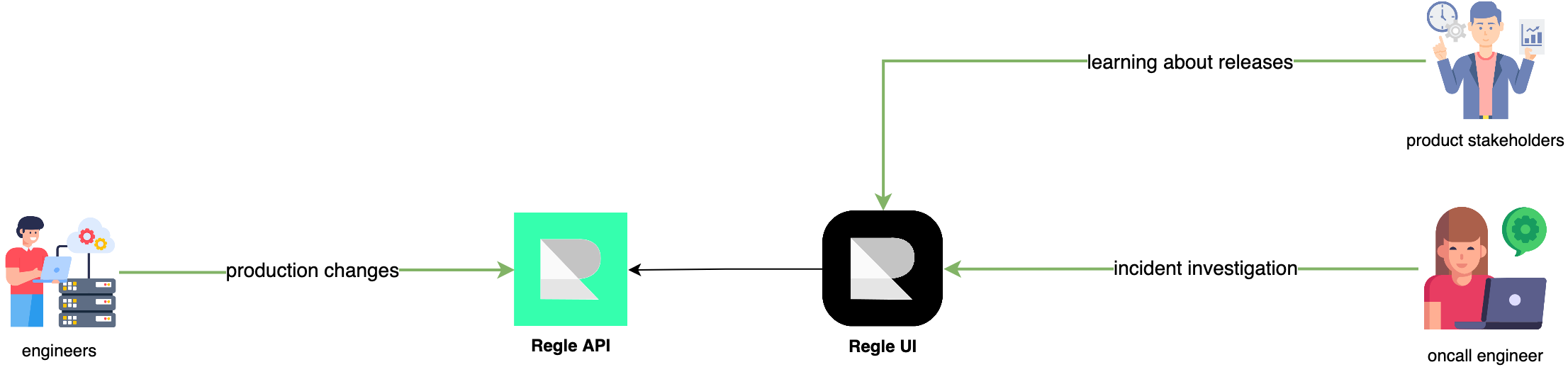
Regle is built on boring, dependable infrastructure:
- Backend API (Go): change/incident ingestion, correlation, monitoring, and notifications
- Web application (Next.js): the Incident, Change, and Monitor dashboards
- Public status pages: customer-facing status for each organization
Next steps
Ready to stop guessing what changed? Get started at regle.dev.